


The costs are local, but the benefits are diffuse. This is the inverse of almost all other industries. As a result, there is little downside to blocking them from your town, so voters will do just that.
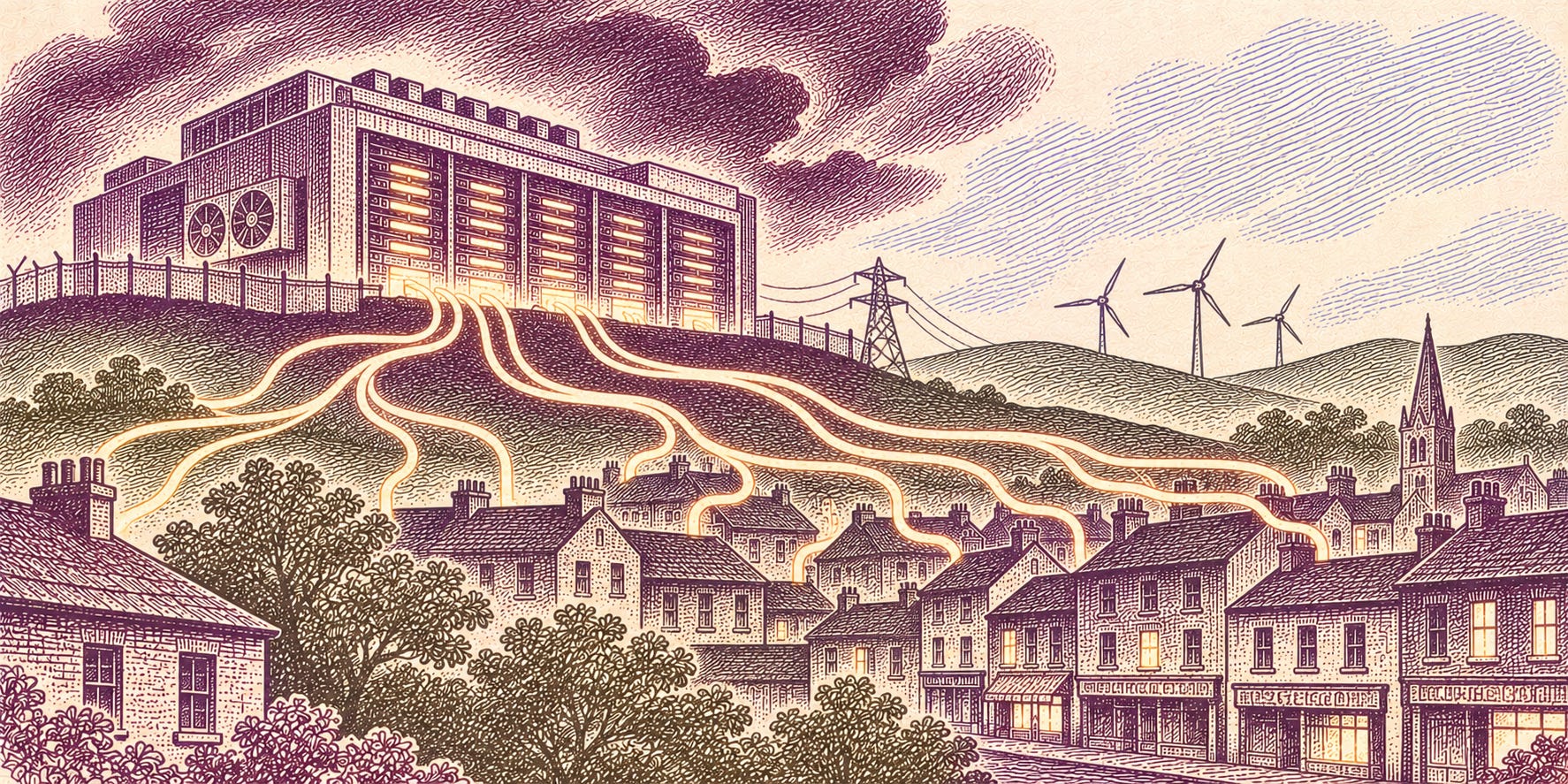
On Tuesday, as part of the US mid-term election, Americans in 10 states voted in favour of 33 ballot measures that will either curb or outright ban the development of Data Centres.
The margins of victory in many of these votes were huge. In Alhambra, California, 82% of residents voted to “prohibit Data Centers in the city” and in Joliet Township, Illinois, 79% voted against a motion to “Advise the city to approve the construction of AI Data Centers.”
It’s hard to think of another industry that voters have rejected this decisively. It is especially noteworthy given that the Data Centre buildout has been one of the biggest contributors to US GDP growth over the last two years, at times keeping the economy out of recession.
When pundits and analysts try to explain this unpopularity, they tend to reach for the negatives - the resource use, the impact on communities, the worries about AI itself. These are certainly real, contributing factors, but there are negatives to lots of industries - factories pollute, warehouses make noise and look ugly, offices create traffic and use energy - but none of this results in a wave of ballot initiatives like we saw this week.
What is unique about Data Centres is not just that their list of drawbacks for local communities is so long, but also that their list of benefits for those communities barely exists.
This results in nobody feeling the need to argue in their defence, or vote in their favour. There is no careful deliberation of the trade-offs in town halls, around kitchen tables or in pub chats, because while all of the costs are borne locally, very few of the benefits are.
This is a bad outcome all round. Data Centres are important economic infrastructure, powering much of the modern internet that we all benefit from. We need to find a way to grow this industry sustainably, in a fair and equitable way, or voters will understandably seek to shut it down.
Stealth Exporters of Energy
For the last 100 years or so, most modern economies have had an assumed social contract with industry, regarding energy. Governments would work hard to ensure the availability of affordable energy to businesses that operate in the state, safe in the knowledge that it would be used to generate economic activity, create value and jobs that pay wages, taxes to fund the treasury, and exports to trade internationally.
Right now the average business (non-household) pays far less for electricity than the average household. In the first half of 2026, for example, Ireland’s biggest electricity users paid 16.5 cent per kWh, less than half the 35.5 cent a typical household paid (before VAT). This is true across Europe, although at prices almost a third lower.
Is it ideal that a factory pays for electricity at a cheaper rate than a household? Not really, but it is politically sustainable because we all assume that the dividends will accrue back to households eventually.
Data Centres break this assumption in a way that I don’t think any other industry has done before.
To see how, let’s consider a few common uses of Data Centres, but describe them more simply as “someone else’s computer”.
You used to back up your photos and videos on an external hard drive, now you save them on someone else’s computer (aka the cloud)
You used to play DVDs on a DVD player in your house, now they’re played on someone else’s computer and sent through the internet to your screen
You used to use your own brain power to write an email, now an LLM running on someone else’s computer generates it for you
With that shift, you’re no longer using just your household electricity for that hard drive or DVD player. Now you (and everyone else) are using the power supplied to that someone else’s computer, which is a massive Data Centre somewhere else in the world.

When an Instagram user in the UK or France or Spain or Portugal is scrolling through videos on Reels, the energy powering that video is likely coming from the Irish grid. (In addition to some from their phone battery to display it, of course).
But this is very different from an Irish factory using Irish energy to make cars for French and Spanish and English drivers. That would create a lot of economic activity in Ireland. “Exporting” a short form video creates almost none.
A useful analogy here might be to imagine that European video watchers are running large extension leads across the Irish Sea to plug their video players directly into our power grid.
In this sense, Data Centres are not like factories where energy is used to make products for export, but rather they are hubs where energy is exported indirectly.

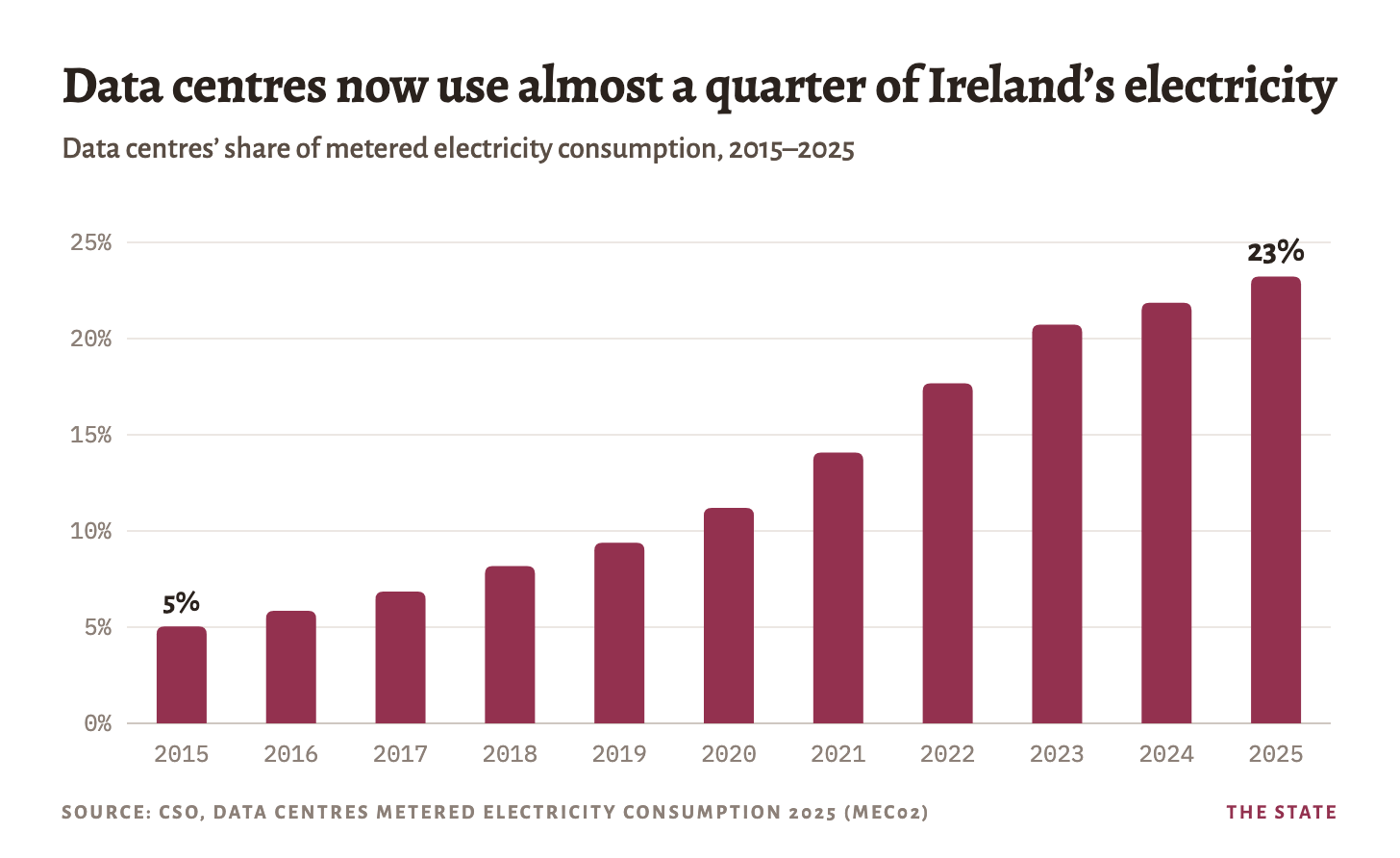
Because of this fact, Data Centres are massive, massive consumers of energy. Data Centres now use a whopping 23% of Irish electricity supply.
23%!!
So in Ireland we are effectively, indirectly exporting almost 23% of our electricity at market price. (I say almost, as some of the video watching is undoubtedly done by Irish people).
What we get from all this energy are is just a few thousand jobs. According to KPMG, just over 11,000 construction-related jobs (which would otherwise be building houses or the Metrolink, one might assume), and about 3,000 people running the Data Centres.
By my crude, back-of-the-envelope calculations, that’s about 150 jobs per percentage point of the country’s electricity usage (380 if you include indirect jobs, and 890 if you include construction), compared to the rest of the economy, which produces about 54,000 jobs per percentage point of electricity usage.
That’s 350 times fewer1 jobs per unit of electricity used.
That’s the true cost here, the opportunity cost of how that power would otherwise have been used. Almost a quarter of our electricity which could otherwise be going to power local businesses, factories, exporters and homes.
Holes In The Bucket
In many ways, this is the inverse of our corporate tax & FDI model. Intellectual property is not geographically bound. It doesn’t have to “reside” anywhere in particular, so we encourage companies (through low taxes) to locate it here. For accounting purposes, all of that value creation can then “happen” here, which allows us to tax that value and reap the benefits, even if it bears little relation to the underlying economic activity.
The exact opposite is true for Data Centres. The end-user-value is ephemeral and not geographically bound. The video watching could be happening anywhere, but the very real energy processing and its associated costs are borne here.
We have somehow managed to create a system that is both pouring huge amounts of ephemeral wealth into the top of the bucket, while also creating lots of holes for it to leak out of the bottom.

Maybe this is our cosmic penance? We are unnecessarily generating the electricity for a Spanish business to use an American company’s cloud-based word processor… but the IP for that software also happens to reside here, so we also collect the corporate tax on it. Karma?!
What’s The Path Forward?
Data Centres need to be built in Europe. We need them to power the internet, to power the AI processing that will underpin the next decade of European business growth, and to provide secure and local options for sovereign compute.
They are also needed in the US, where their economy will benefit hugely from the fact that all of the leading AI labs are currently American.
The benefits in both regions, however, are national, while the costs are local, so Data Centre construction will continue to face massive political opposition in both.
There are many pathways worth exploring. Data Centre energy use can be taxed or charged at a higher rate. They can pay higher rates of local property tax. They can be charged higher commercial rates. (Substantially higher). They can be forced to pay up front for the capital build out of new (low carbon) energy sources. Ideally some combination or all of the above.
We already do something like this for onshore wind farms. Every RESS project pays €2 for each megawatt-hour it generates into a fund for its neighbours, and every house within a kilometre gets €1,000 a year. The companies that build Data Centres have much deeper pockets, and much more urgency to get these things built. I’d imagine the price you could charge for predictable, rapid development would be eye-wateringly high.
If we approach this with ambition and pragmatism and price our resources confidently, either the development stops and goes somewhere cheaper (and locals are happy) or it proceeds, and they meet not to protest, but to plan how they’ll spend the new windfall.
One three hundred and fiftieth, to be more accurate