


The big news story in Irish healthcare this week is really about the power to set the scorecard for a CEO’s performance, and who gets to mark it.

Last weekend, two CEOs sat anxiously by their phones, on either side of the Atlantic.
In California, Jensen Huang got a happy call from his board to tell him he had been reinstated as Nvidia’s CEO, after 11 days in the wilderness.
In a less sunny Ireland, at 7.30am on Saturday, Anne O’Connor joined a Teams meeting with the chair of her board, who let her know that she would no longer be the CEO of the Health Service Executive.
Just eight months after taking the helm of the giant, 150,000-person organisation with a €29bn budget, she was out.
Both of these decisions are the outcome of a process conducted by two boards, shrouded in mystery and intrigue, which sought to create a scorecard against which to mark the performance of these CEOs. These scorecards have been shifting, they have been altered by ministers and presidents, and still remain a secret.
What the fallout from both incidents has highlighted is just how difficult this seemingly simple question turns out to be – how do you create a scorecard for CEOs and who gets to mark it? Or put more simply, how do you decide to fire a CEO?
The Value of a Single Metric
The history of thinking on this topic is surprisingly recent.
Even though we have had boards of directors since we had the very first company, they were mostly comprised of friends of the managers, occasional advisors with an unclear role, or prestigious names that hopefully made you look good by association. In his 1971 book on the topic, Myles Mace quipped that
“You’ve got to have the names of outside directors who look impressive in the annual report. They are, after all, nothing more or less than ornaments on the corporate Christmas tree. You want good names, you want attractive ornaments.”

The modern, independent board of directors, whose job it is to keep the management team accountable, only became commonplace from the 1990s onwards, and the thinking behind them was heavily influenced by an academic named Michael Jensen.
In the early 1970s, Jensen was bugged by a simple question, in his own words:
“What are we trying to accomplish? Or, put even more simply: When all is said and done, how do we measure better versus worse? Even more simply, How do we keep score?”
In asking these questions he began to develop a branch of management theory called agency theory, exploring how to account for the fact that we often need experts to act on our behalf (agents), but that they also have their own interests and motivations, which might be in conflict with our own.
This is why we make financial advisors disclose any kickbacks they might get from the products they recommend, or give estate agents a percentage of the sale price, to hope they are aligned with our desire (a high price) rather than theirs (a quick sale).
In the same way that a estate agent acts on behalf of the house seller, the CEO (and management team) can be said to be acting on behalf of the owners of the company, or in the case of a public body like the HSE, acting on behalf of the public, or the minister as their representative.
Applying agency theory to the company, Jensen wondered how we might ensure that managers are acting in ways that are aligned with the interests of the company’s owners and society more broadly.
“At the economy wide or social level, the issue is the following: If we could dictate the criterion or objective function to be maximized by firms (that is, the criterion by which executives choose among alternative policy options), what would it be? Or, even more simply, How do we want the firms in our economy to measure better versus worse?”
Jensen argued in favour of a simple, objective measure – company value. If someone was willing to buy a slice of the company (i.e. a share) for more tomorrow than today, then the manager can be said to have done a good job.
This argument, known as shareholder value, took hold, and is now the cornerstone of modern corporate governance in the English-speaking world. It has changed how we imagine (and codify in law) the roles of independent boards of directors, and has in turn influenced how we structure public bodies.
There are several problems with Jensen’s theory (which we’ll address later), but first it’s worth asking if it’s even possible to have some equivalent of an “objective function” for a public good like healthcare.
If we can, then it might help us assess whether or not it was right to fire the CEO, just by asking if the value was being increased during her tenure.
What Is Value?
Many have certainly tried to define Jensen’s “objective function to be maximised” for healthcare, with mixed results.
One well-known attempt at this is the quality-adjusted life year (QALY), which seeks to measure the benefit of any medical intervention by looking at the number of extra years of life it gives to the patient, but also adjusting for quality, because two great years might be better than five miserable ones.
With a metric like this in hand, managers can start making decisions in a more objective and consistent manner. To quote Jensen again:
value creation gives management a way to assess the tradeoffs that must be made among competing constituencies, and […] it allows for principled decision making independent of the personal preferences of managers and directors.
In the early 2000s, Tony Blair’s government tried this with a narrower metric – waiting times. In a programme that was later nicknamed “targets and terror”, they set explicit targets (e.g. 98% of A&E patients seen, treated, admitted or discharged within four hours) and punished hospitals that missed them, including by firing management.
Although there were several measures, they were all combined in a consistent manner into a single star rating (each hospital got 0, 1, 2 or 3 stars), and that was the guiding measure of value.

In many ways, it was a success, with waiting times falling consistently when it was applied. It also had some flaws. From the LSE:
research showed that linking high-powered incentives to targets will result in improvements in reported performance and also in attempts to game the system, such as ‘hitting the target and missing the point’. This highlighted two strategic lessons for policymakers on when such an approach will and will not result in improved performance outcomes for public services. First, targets with sanctions can work when the targets accurately measure key dimensions of performance that cannot easily be manipulated by gaming. Examples include hospital waiting times, ambulance response times and school league tables.
Second, where targets can only be framed as proxies for important dimensions of performance, the manipulative effects of gaming may undermine their use.
In England there were (possibly apocryphal) stories of staff cutting the wheels off trolleys, so they would be counted as beds, of ambulances waiting outside an A&E so the clock wouldn’t start, and stats showing that discharges would spike right before the four-hour mark.
Despite the gaming, no reform since has cut English waiting times as far or as fast.
In Ireland, there have been attempts to bring some of these explicit targets into effect. The Sláintecare report of 2017 recommended writing the following into law:
No one should wait more than 12 weeks for an inpatient procedure, 10 weeks for an outpatient appointment and ten days for a diagnostic test
Introduce a maximum wait time in EDs, working towards a four-hour target
Hospitals that breach guarantees are held accountable through a range of measures including sanctions on senior staff, but not to the detriment of healthcare delivery
These recommendations have yet to be fully enacted.
The lesson to be learned from England is not that we should avoid holding people accountable to targets, but that we should take the early success and refine it. Get better at using accountability metrics to drive performance, while refining their ability to be gamed.
One angle we might explore is the idea of a single score, like the star rating used by the NHS. Would we have better off having a wide variety of objectives, one for each of the important parts of the healthcare system – like wait times and patient outcomes and staff satisfaction? Is that the better way to measure how well the CEO is doing?
Stakeholders vs Shareholders
After Jensen’s theory became popular in the private sector, the problem of gaming became quite obvious there too. This was the nasty “greed is good” streak of the late 1980s, and the late 1990s and early 2000s brought terrible financial crimes and crises.
Managers were increasingly paid in company stock, to align their incentives with shareholder value, but they quickly began to capture compensation committees, use back-dated options and other tricks to massively inflate their pay.
Jensen himself later said this backfired in a 2005 paper, which looked at the dot-com era failures (WorldCom, Enron, Nortel, and others) where managers fuelled preposterous company valuations.
The biggest competing theory for Jensen’s is called “stakeholder theory”, which argues that a company should create value for all parties affected by its operations, such as employees, local communities, customers and government, not just shareholders.
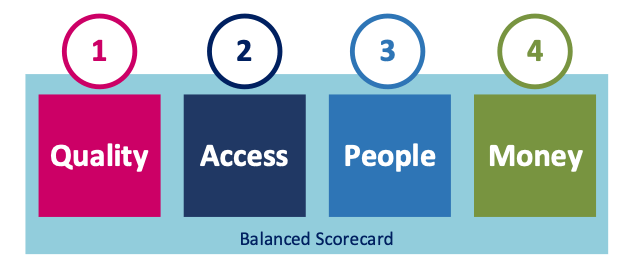
When we look at the HSE, we can see some of this approach evidenced in their public documents. Their Performance and Accountability Framework provides this “balanced scorecard”
And the board has recently said that the CEO was being measured against this list of objectives:
Financial management and expenditure control
Urgent and emergency care performance
Waiting list management
Organisational reform
Workforce management
Stakeholder engagement
Board assurance and governance
This is all well and good, but the problem with the balanced scorecard approach is that it contains no indication of priorities, and therefore is not a useful tool for managers when they’re making trade-offs.
In healthcare, as in most areas of public policy, the trade-offs are what actually matter. Our healthcare system is full of brilliant, highly educated people who are passionately committed to their work. What they need from the political system is not instruction on how to do their job, but a framework that helps them make difficult trade-offs.
Do we build a new children’s hospital or ten new nursing homes? Is it OK to give better care, but further from people’s homes? Is it better that people are seen more quickly, or more comfortable while they wait?
Somebody has to make these decisions, and if they’re not codified somewhere, then they will be made sporadically and inconsistently, in a very costly manner. Here’s Jensen again:
The balanced scorecard is the managerial equivalent of Stakeholder Theory. Like Stakeholder Theory, the notion of a “balanced” scorecard appeals to many, but it is similarly flawed. When we use the dozen or two measures on the balanced scorecard to measure the performance of people or units [….] We are asking them to maximize in more than one dimension at a time with no idea of the tradeoffs between the measures. As a result, purposeful decisions cannot be made.

The Power To Set The Weights
The balanced scorecard approach is not only insufficient for decision making, it is also problematic for accountability, as it allows for a huge amount of slipperiness. It gives managers very wide discretion by letting them pick which constituency (workers, customers, the environment, or shareholders) justifies a decision, including decisions that might be made in their own interest.
Financial columnist Matt Levine had this insightful critique:
One essential feature of “stakeholder capitalism” is that it gives boards and executives more freedom. If a company’s job is not just to maximize financial returns to shareholders, but also to do good for the environment and workers and customers, then anytime the shareholders say “we want you to do X,” and the board doesn’t like X, it can say “well that would be bad for workers.” And if the workers say “we want you to do Y,” and the board doesn’t like Y, it can say “well that would be bad for shareholders.” There’s always some constituency that will like something, and some constituency that won’t, and the board gets to choose which constituency counts. There is no single standard to hold the board accountable to; the board just chooses which stakeholders matter for any particular decision, so it can make the decision that it wants.
Now I think we’re starting to get closer to the crux of the issue with the HSE. A laundry list of objectives, with no clear ranking or prioritisation, has introduced a huge amount of subjective discretion into the mix. Given that the CEO was still on probation, this mostly translated into power for the board.
This is why, a week after the CEO was fired, we are still unsure if it was justified or not. We don’t know if she failed to improve the system, because we don’t know how improvement should be measured. We are still plagued with Jensen’s question from 1971:
When all is said and done, how do we measure better versus worse? Even more simply, How do we keep score?

So what should we want to see happen before the next CEO gets appointed? Is it condensing of all of these objectives into a single dimension, as Jensen describes?
Before we commit to that approach, it’s worth noting that this would explicitly shift power away from the board, and undermine its expertise.
C. Thi Nguyen is a philosopher of games and author of “The Score” (the best book I’ve read this year). In it, he says that the benefit and limitation of single-dimension metrics is that they compress messy, context-rich reality into simple numbers that travel easily across people, teams, and institutions.
Take Leaving Cert points, for example. An English teacher might have deep context about a student’s aptitude for poetry, their creativeness, or their difficulty with spelling. But how do you compare this with a speed at acquiring new concepts in maths, or a flourish in art?
You can’t, so you reduce all of these dimensions down to a single one – a score – to make it comparable.
You might enjoy spending hours in endless pub banter over whether Messi is better than Ronaldo. It’s fun! But at the end of each week in the Premier League, we need to know who won, lost or drew so that we can move the league on. Scores feel brutish and simplistic, but without them we’d be lost in subjective roundabouts forever.
Nguyen argues that part of the power of simple scores for accountability is that they are actually “anti-expertise”. An expert in any given subject is easily able to assess performance over multiple dimensions, weigh them in the context and make a decision.
What becomes difficult is when an expert has to be accountable to a non-expert. In these instances, simple metrics become a tool of the non-expert, to force the assessment into a form that is accessible and understandable by them, even at the expense of nuance and context.
This is exactly the role that a board of directors is supposed to function - making managers accountable to other experts, who can use discretion to assess many dimensions and make a more subjective call, without sacrificing context.
The difficulty is that it brings back the slipperiness that Matt Levine described. This gives power to the board, in a situation like this, where the CEO is still on her probation period. Management will inevitably involve a trade-off between these elements, so if you want to get rid of a CEO, there will always be some elements you can point to as underperforming, without knowing whether it was underperforming or just de-prioritised.
The CEO may have been sacked because she was underperforming, based on the board’s subjective interpretation of the numbers… or she may have been sacked because they, or the minister, don’t like her. Right now it’s quite hard to tell the difference.
So where do we want this power to lie in Irish healthcare? How should we benefit from the subjective expertise of a board, without delegating too much power and discretion to them?
What Have We Tried?
We have been dancing around this, in lurches, over the last two decades. In 2013, then Health Minister James Reilly disbanded the board of the HSE, took the power to set objectives directly under his control, but as far as I can find, never published any.
In 2017, the cross-party Sláintecare report stated simply that:
“The Committee believes that the current HSE governance structure is not fit for purpose. An independent board needs to be put in place.”
The board was reinstated in 2019. It currently has a fairly robust framework in place for accountability, at least in terms of structure:
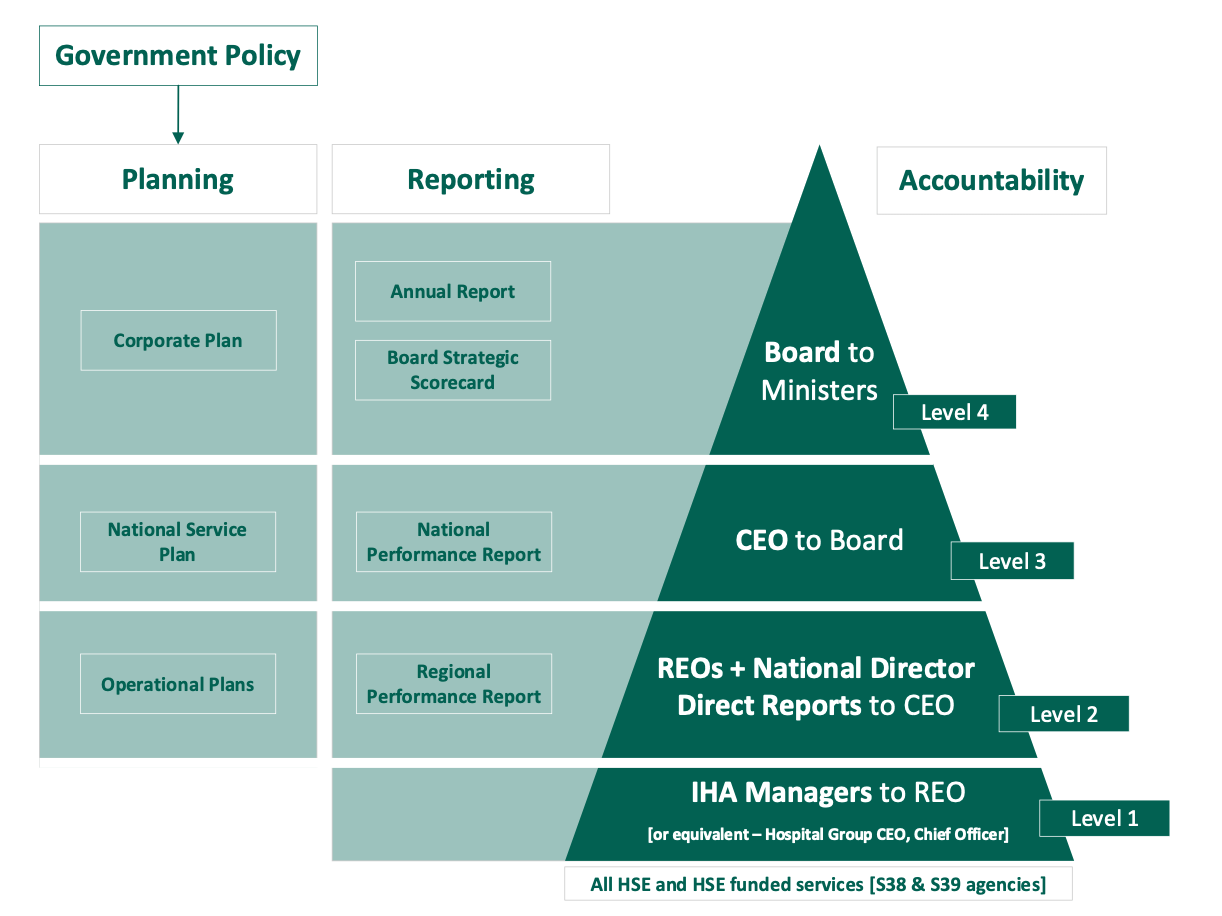
What’s less clear, however, is the scorecard.
The HSE introduced a Board Strategic Scorecard in 2021, which had 20 scorecards across areas such as unscheduled care, bed capacity, eHealth, disability reform, home support, the health regions, recruitment and retention, and patient partnership. Each had a few KPIs and was given a rating from 1 (not on track) to 5 (on track) against an annual "ambition statement".
This is a reasonable balance of objective metrics (rating) with subjective expertise (on track against an agreed goal).
But what about the prioritisation? These did indeed aggregate up to a single metric, published in the board minutes, but it seems to have been just a simple average across all 20, with no weighting and therefore no prioritisation. (Getting patient partnership numbers up was de facto as important as bed capacity, for example).
It would be interesting to look at these over the tenure of Anne O’Connor, but unfortunately they were stopped in 2024, and replaced by a monthly National Performance Report.
Was this a refinement of the Strategic Scorecard, to get more explicit with the priorities and give guidance on the hard trade-offs? Did it codify a score? From the HSE’s framework:
Headline indicators for the health service performance are captured in a National Balanced Scorecard which represents performance through four lenses or domains. As set out in Section 1.4, the four domains used by the health service are Quality [including Safety], Access, People and Money.
The use of the National Balanced Scorecard is to ensure that no one domain dominates when measuring the performance of a service. The National Balanced Scorecard is included in the National Service Plan.
Gaaaaaah! One step forward, two steps back.
Michael Jensen died a few months before this new framework was implemented, but luckily we still have his wisdom to remind us that of course all domains should be considered and balanced, and competent management will do that, but you still need a score to hold them accountable:
Indeed, it is obvious that we cannot maximize the long-term market value of an organization if we ignore or mistreat any important constituency. We cannot create value without good relations with customers, employees, financial backers, suppliers, regulators, communities, and the rest. But having said that, we can now use the value criterion for choosing among those competing interests. I say competing interests because no constituency can be given full satisfaction if the firm is to flourish and survive.
So now the board gets a report that looks like this every month:
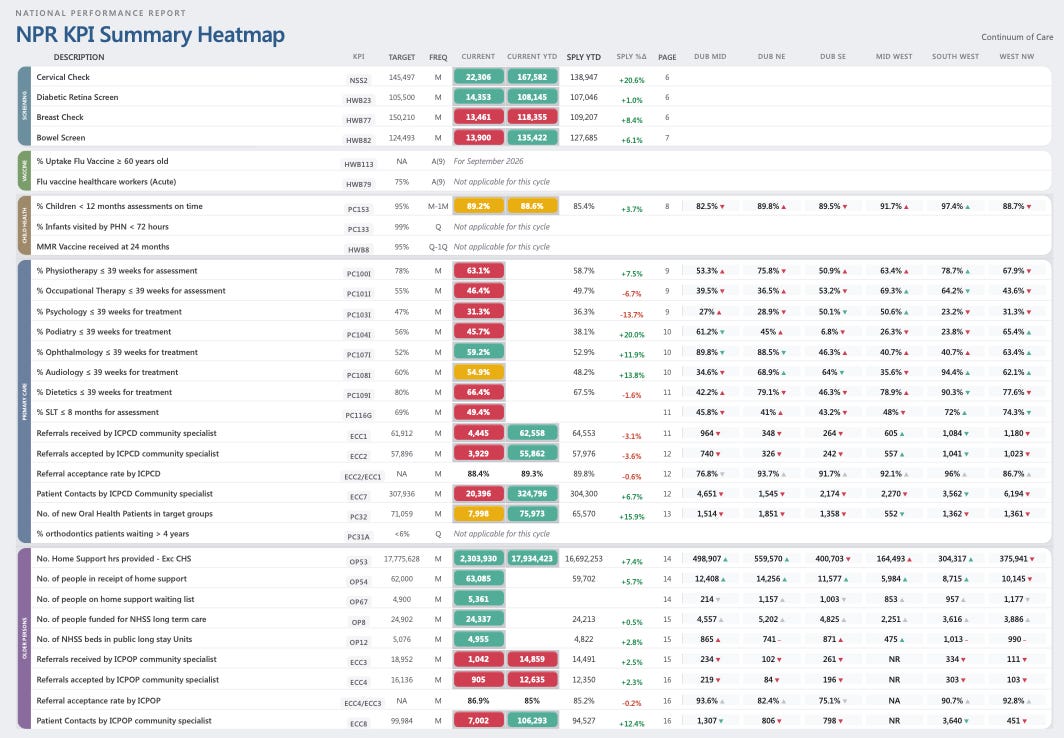
This is great data, with real targets and KPIs in there too. The overall question that we posed at the start of this article – how do we know if the HSE is doing a good job? – is a subjective interpretation of these objective measures.
The Minister sends a Letter of Determination to the HSE (which is unpublished) every year and the HSE publishes a National Service Plan, with a list of priorities. So we’re not a million miles off where we need to be.
What Should We Do?
Ultimately, what we should be trying to work towards is a system with the following characteristics:
The political system expresses the “value” we are working towards, through legislative debate and ultimately enforced by the minister
The board sets out a small number of shorter-term objectives, with associated metrics, which it believes will optimise for long-term value. These need to have an embedded prioritisation within them, and the relative weights of each should reflect the value set by the political system.
The board is made up of subject-matter experts, so should have some subjective freedom. The CEO and management should have discretion on implementation and the “how” to get there. All should be held accountable to increasing the value.

No country has solved this completely. My ideal vision for a published set of weighted priorities is admittedly politically challenging, so nobody publishes a formula explicitly saying, for example, that a trolley wait is worth 0.3 of a cancer target. But some countries have written the trade-offs down, in public, and agreed them.
They do this mostly by setting principles for prioritisation, rather than numeric weights. In 1997 the Swedish Riksdag endorsed a ranked set of three: human dignity first, then need and solidarity, with cost-effectiveness allowed in only after need has been served. Norway put its own criteria into law two years later. Every priority decision weighs how much benefit a treatment brings, how severe the condition is and how many resources it uses, and the more severe and beneficial the treatment, the more it may cost. These aren’t weights in the arithmetic sense, but they can play a similar role.
Norway, Sweden and New Zealand also all publish their letter of expectations from the minister to the health services, which set out the priorities for the year ahead.
If we were to learn from these and the NHS success under Tony Blair, I think the ideal wishlist for Ireland would be as follows:
The Oireachtas should set a ranked set of principles for healthcare in Ireland. The Sláintecare report, which was agreed by all parties in 2017, has listed several priorities. We should go one step further and try to codify the ranking between them.
The Minister should publish the 2027 Letter of Determination, and it should have a clear ranking of priorities within it.
The HSE’s National Performance Report should have a single, top level score. The weights of each target should be mechanical, but the rating can be subjective (e.g. the board decides by how much a target was missed or exceeded).
People should be held accountable to this score, although some subjective discretion can remain – e.g. the board can account for a pandemic, or severe weather events, etc. when assessing performance against targets.
DPER should help formalising this process across all departments, not just health.
If we don’t have a scoring system, then we have a framework with no true priorities, which no CEO can effectively implement, or be held accountable against.